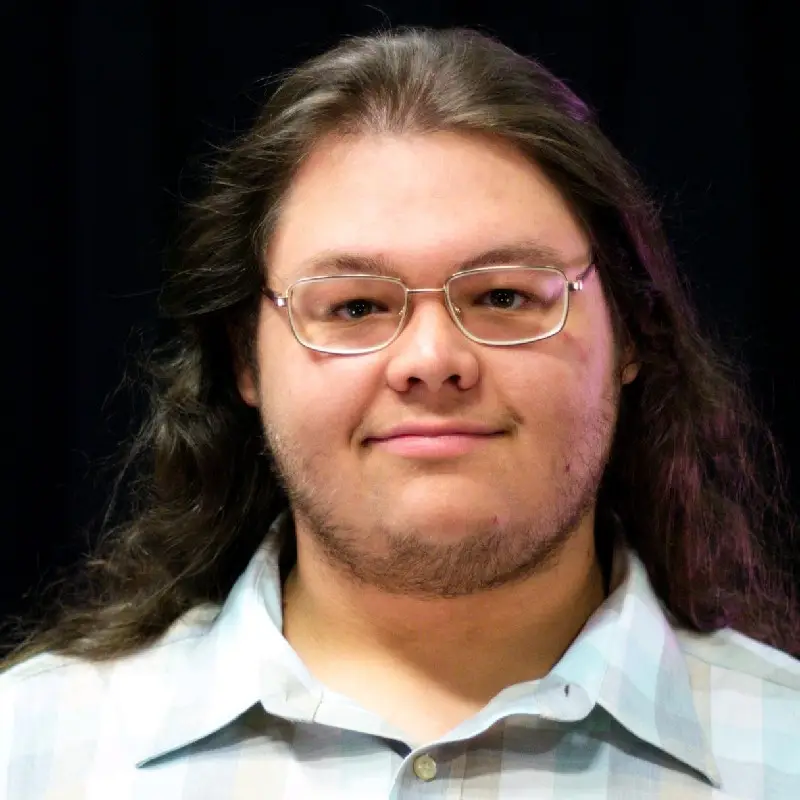
Meet Matthew Giallourakis, Haneke Design’s newest Lead Mobile Developer.
Matthew joins our team with 12 years in the programming industry, and his experience spans all the way back to his high-school robotics program.
 He graduated from Florida Polytechnic University with a Bachelor’s degree in Mechanical and Industrial Engineering with a focus on Nanotechnology. He then went on to earn his Master’s degree in Engineering, with a focus on Electrical Engineering and Robotics.
Ever since, he has been fine-tuning his programming skills and has established himself as an expert in various areas such as Native Android Programming, Mobile Frameworks, Scientific Computing, and Microcontrollers.
About 5 years ago, Matt began expanding his programming knowledge and expertise into the world of Generative Art.
“I first started making computer animations to help myself visualize some of the more advanced robotic movements in my kinematics class in college. From there, I became inspired by content creator LeiosOS’s review of a paper on ‘Fractal Frames’ – I remember being absolutely mesmerized by how such intricate patterns could emerge from such simple programs,” explains Matthew.
What is Generative Art?
Generative art refers to a technique in which the artist creates images using computer algorithms. It is considered to be the artistic intersection of programming, computer graphics, and individual expression.
Originally coined by German philosopher Max Bense in 1965, the term describes works of art that are based on algorithmic code or mathematical formula to generate forms, shapes, colors, patterns etc.
Generative art is a collaborative process between the artist and machine.
First, the artist creates rules that provide boundaries for the creation process. Then, a computer follows those rules to produce new works of art.
“I love that most of it is built on top of simple rules and deep mathematical concepts. Most of the mathematical tools that I learned in college are hiding somewhere in the art that I make,” says Matt.
You can check out more of Matt’s art on his Twitter page, @Foldsterproject.